On November 9, 2008, CBS featured a story about "recycling" electronic waste, that is actually channeled from the US into China. It describes "one of the most toxic places on Earth," where the "blood of children is laced with lead." "The Electronics Wasteland" news segment reveals that so-called recyclers are actually shipping e-waste overseas and mined for precious metals. T.H.E. Journal features some links for certified ethical recycling if you want to make sure you're recycling properly: http://www.thejournal.com/articles/24101_6 . There's also an interesting article there called "The Dirt on E-Waste" by Dian Schaffhauser.
Tuesday, March 31, 2009
The Electronic Wasteland/60 Minutes
On November 9, 2008, CBS featured a story about "recycling" electronic waste, that is actually channeled from the US into China. It describes "one of the most toxic places on Earth," where the "blood of children is laced with lead." "The Electronics Wasteland" news segment reveals that so-called recyclers are actually shipping e-waste overseas and mined for precious metals. T.H.E. Journal features some links for certified ethical recycling if you want to make sure you're recycling properly: http://www.thejournal.com/articles/24101_6 . There's also an interesting article there called "The Dirt on E-Waste" by Dian Schaffhauser.

Friday, March 27, 2009
New Technologies, New Country
 This last week, I was in Belize on a World Leadership School trip. Our school sent 14 middle school students, along with myself and two other teachers, to study Climate Change and perform a service project in this tiny Central American country. Our service project was to raise enough money to provide five laptops for a small school in La Democracia, Belize District. According to BTL, Belize's only telecom provider, they will provide free internet service to any school that can prove it has at least five computers. So, that was our aim. Also while we were there, we taught the students how to use the software installed, and completed short video projects. You can view the completed projects and read a semi-daily journal of our experiences on the trip Wiki. My most proud moments:
1. Realizing that the parents were "camped out" in front of the wiki back at home, waiting for our students to blog each night.
2. Listening to our students ruminate on what it will take to make a difference in the climate change phenomenon, and coming to the conclusion, all on their own, that values have to change.
3. Watching Belizean students who have never used computers before jump right in with both feet and take control of the mouse!
4. Hearing the Standard 5 & 6 classroom teacher Mrs. Pech say that her heart was overflowing with gratitude because of what she knows this will bring her students.
Wednesday, March 11, 2009
Boolified!
We did try out the Boolify Search engine I blogged about here and the results are in. At first glance, students are grasping boolean logic in a way they never have before! Check it out:
Friday, March 6, 2009
Image-Based Learning= Cave Drawings?
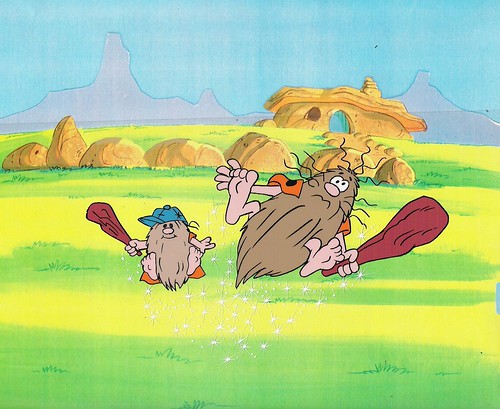
 For the last eight years I have been teaching technology, I've noticed that children seem to learn easiest from visual tools. They sit up and listen when a point is illustrated by a photo or by a short video clip. They love interactive games. This is likely no big revelation to most people in the field. However, I got to thinking the other day that this may be a regression of sorts: our prehistoric cave drawings returning as the choice medium of communication. Reading text is harder, there is decoding and meaning-making involved that simple image recognition does not involve to quite the same degree. That's not to say that decoding images is facile, I just mean that construing meaning from text is more difficult. I am reminded of social philosopher Marshall McLuhan's warnings that we are devolving back into a "global village" mentality, in which the image is the primary mode of communication--overcoming years of self-imposed text-based book learning, which is challenging for the human brain.
So, in appealing to these more instinctual meaning-making modes for human beings, are we appealing to the easiest way to make meaning? Are we dumbing kids down? The rational side to me says: "Of course, Alecia, everything requires balance and moderation." There are few teachers advocating exclusively image-based instruction. It should be only one modality of many. But STILL! Is it true that we are offering a little bit of candy with the broccoli bits when we utilize image-based teaching techniques? Sure, a spoonful of sugar helps the medicine go down, but are our kids beginning to prefer a more primitive image based mode of comprehension? And if they are, is that bad? I'm not saying it is, but I'm thinking about it.
Image: http://farm4.static.flickr.com/3511/3205302773_9b242326b5.jpg
Image: http://farm4.static.flickr.com/3511/3205302773_9b242326b5.jpg
Tuesday, March 3, 2009
Wildlife Filmmaker
 National Geographic is offering a Wildlife Filmmaker using their stock film clips, music and even sound effects. The format is very similar to Windows Movie Maker and iMovie, so it's like training wheels for students just about to learn these tools. This would be ideal for younger students, grades K-2 or maybe you could stretch it to grade 3. I read about it in Learning and Leading with Technology's Dec/Jan 08-09 issue and tried it out with the Kindergarteners who learn about animals in native habitats. Downside: you can't download the clips. You can save them with a numeric code, but no letters. At best you can get a URL to share with parents and it's not clear how long they'll be available for viewing. Upside: These videos turn out looking quite professional and can be done in two 45 minute periods.
Image: ilearntechnology.com