Project Tomorrow
 sponsors
Speak Up, which is a "national research project that surveys K-12 students, teachers, parents and administrators." One of the questions asked recently was "
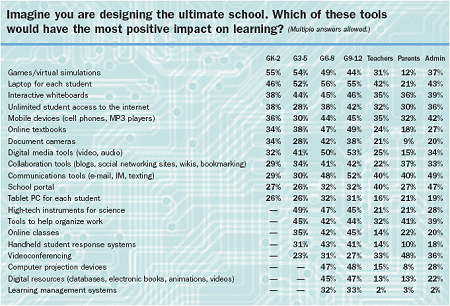
Imagine you are designing the ultimate school. Which of these tools would have the most positive impact on learning?" The
results of this survey were tallied and reported in the March 2008
T.H.E Journal. Which areas showed the most disparity between teachers and students?
- 25 % of teachers feel that
Digital Media Tools like video and audio would have the most positive impact on learning. The students in grades 6-8 rated it 50% and grades 9-12 53%.
- 24% of teachers feel that
Online Textbooks would have the most positive impact on learning. The students in grades 6-8 rated it 47% and grades 9-12 49%.
- 21% of teachers feel that
Document Cameras would have the most positive impact on learning. The students in grades 6-8 rated it 42% and grades 9-12 38%.
-- 15% of teachers feel that
Computer Projection Devices would have the most positive impact on learning. The students in grades 6-8 rated it 47% and grades 9-12 48%.
There are quite a few more that show the same disparities. The numbers for parents and administrators are wildly varying. What do I think this reveals?
- A basic lack of understanding of the potential benefits for some groups.
- A possible fascination with "toys" for some groups.
- A fear that moving towards online classes may fundamentally change educators' jobs.
- A resistance to change (this one's a duh because of course we as humans are resistant to change.)
The most important thing that it reveals, however, is the sea-change in which we are all dog-paddling. Teachers, students and administrators alike are grappling with the possibilities these new technologies offer and perhaps the only "true thing" upon which we can rely in the future is that new technologies will likely keep on coming our way and we'll never get to stop taking surveys like this again.
Image credit: www.marcumsmith.com
 In the March/April issue of Learning and Leading with Technology, there was a great article called Traveling the Novel. Two teachers at Harpeth Hall School in Nashville put together a step-by-step guide to how they use Google Earth to enrich their literature studies in English classes. The article specifically discusses their projects for The Kite Runner by Khaled Hosseini and one on the Iditarod. These seem a lot like Google Earth Lit Trips, but with the added dimension of requiring students to post quotes/photos and other responses directly on the .kmz file. I've sent the teachers an email asking how they evaluate success on the project and I hope to hear back from them. In the meantime, their wiki "Harpeth Hall Uses Google Earth" has links to the Google Earth files they have already created. Incidentally, they also include directions for using Google Earth!